


Our Survey
Thank you!
The Nova Scotia Quality of Life Survey is now closed. We thank everyone who took the time to participate in the largest undertaking of its kind in Canada.
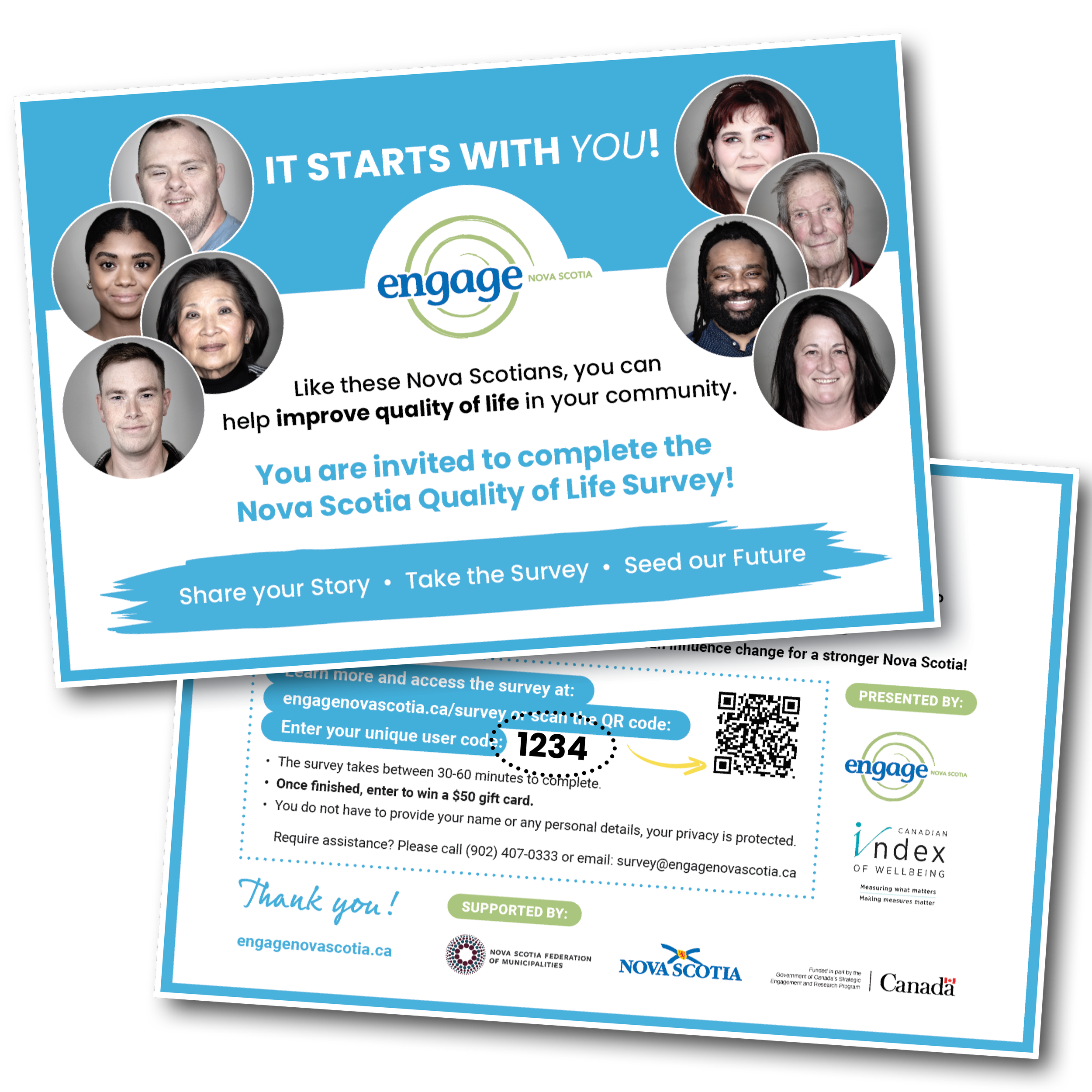
We acknowledge the commitment and time it took to take 30 to 60 minutes to answer important questions around affordability, housing, loneliness and trust in institutions.
We expect to have early results from the survey in the fall of 2026. More detailed reports will begin rolling out in early 2027. Please visit our website for updates and our FAQs page for any other questions you may have.
Why this matters and what’s different about the survey
The Nova Scotia Quality of Life Survey asks over 200 questions about your quality of life.
We ask questions not found in other surveys.
Apart from obvious questions about health, housing and affordability, the survey explores topics of trust in others and institutions, confidence in democracy, experiences of loneliness and discrimination, job satisfaction and even connection to nature.
-
The survey reveals a fuller story of what previously was statistically unknowable or ignored.
A diverse outreach team is already mobilized to engage Nova Scotia residents in conversations about quality of life, and ensure the survey results are statistically valid when representing systematically marginalized individuals and communities in Nova Scotia.
These insights help us inform partners and the public on how our wellbeing has changed from before and after the pandemic by comparing the results from the two different survey periods.
-
Close to 13,000 people responded to 230 questions, making it the largest single well-being dataset of its kind in the world.
More than 150 volunteer community leaders created nine regional leadership teams, hosted public engagements, and set priorities for a better future.
We’ve been sharing the results widely and equipping people to use them.
We have also witnessed some of the most tangible examples of how the data has ‘moved to action’.
Our data and tools became the backbone for a project to examine the lived experiences of residents in Cape Breton Regional Municipality (CBRM), with disabilities, living with low incomes and who are young adults and single parents. This prompted the council to more strongly signal its support for “social inclusion” as a high-level goal to balance economic and population growth.

The Canadian Index of Wellbeing (CIW) at the University of Waterloo is our research and methodology partner. They are one of the globally leading experts in the field of wellbeing.
In the past, policy decisions were mainly based on economic data. While those data are important, they are incomplete on their own. So we asked Nova Scotia residents the following:

How should we measure success on a scale from 1 to 10?
The results (May, 2026):
59% said: By growing the economy.
83% said: By improving our quality of life.
Measuring and improving quality of life has become central to progress in some of the most successful jurisdictions in the world, and the Nova Scotia Quality of Life Initiative is widely considered to be a leading project of this type.
Our Promise
Our promise to survey participants - and to all Nova Scotians - is that the data will be used by all sectors and advocates, in all regions of the province, to improve quality of life.

Our tools move data to action
In collaboration with Dalhousie’s Faculty of Computer Sciences, we built groundbreaking tools so the data from our surveys are accessible to all.
See our Wellbeing Mapping Tool and a description of the Wellbeing Analysis Tool.